English
 Deutsch
 España
 Français
 Italia
 Русский
 عربي
عربي


A Mezzanine Gate is a dual-barrier safety system installed at elevated pallet drop openings and mezzanine edges that keeps a physical guard in place at all times, even while a pallet is being loaded or unloaded. Unlike a swing gate or a chain, a properly engineered mezzanine gate uses two independent barriers so that one side is always closed, which is the exact principle OSHA and ANSI require for floor openings four feet or higher. Installing a compliant mezzanine gate removes the single most common cause of serious injury at height in warehouses and manufacturing plants: an unguarded floor opening.
What a Mezzanine Gate Does and How It Works
A mezzanine gate is mounted directly onto the guardrail system at the edge of a mezzanine, pick module, or elevated platform where pallets are loaded or unloaded by forklift. The gate consists of a ledge-side barrier and a rear-side barrier connected so that raising one automatically lowers the other. When the ledge gate is raised to let a lift truck set a pallet down, the rear gate lowers to block worker access to that opening. Once the pallet is in place, the operator raises the rear gate and lowers the ledge gate, sealing the edge again before anyone can step near it.
The Dual-Barrier Principle
This mechanical interlock is what separates a true mezzanine gate from a basic swing or sliding gate. A single-barrier gate can be propped open by a pallet or left open by a distracted worker, leaving the opening exposed. A dual-gate design makes that scenario physically impossible, because one barrier is always closed by construction, not by habit.
OSHA and ANSI Requirements That Apply to Mezzanine Gates
In the United States, fall protection at elevated openings is governed by OSHA's Walking-Working Surfaces standard, 29 CFR 1910.28, which requires a barrier at any exposed floor opening four feet or higher, and the barrier must remain in place even while the opening is actively used for material handling. ANSI MH32.1-2018 goes further for material handling structures, stating that single-barrier gates such as swing, sliding, or lift-out models do not meet the standard because they can be held open during loading.
According to OSHA injury data, falls to a lower level caused the deaths of 302 non-construction workers in 2021, and workplace fall injuries commonly carry workers' compensation claims averaging more than 36,000 USD per case, with fatal incidents costing employers well over 1.4 million USD once medical, legal, and operational costs are included. These figures illustrate why a compliant mezzanine gate is treated as a core piece of safety infrastructure rather than an optional accessory.
- OSHA 1910.28 requires fall protection at any exposed edge four feet or higher.
- ANSI MH32.1-2018 requires a barrier in place even during active loading and unloading.
- The International Building Code references similar guardrail and opening-protection requirements for elevated platforms.
Dual-Gate Versus Single-Barrier Gate Designs
Choosing between a dual-gate mezzanine gate and a single-barrier alternative has a direct effect on both compliance and daily safety. The table below compares the two approaches on the factors that matter most to safety managers.
| Factor | Dual-Gate Mezzanine Gate | Single Swing or Sliding Gate |
| Barrier during loading | Always closed on one side | Often propped open |
| ANSI MH32.1-2018 compliant | Yes | No |
| Depends on worker habit | No | Yes |
| Power operation available | Yes, electric or pneumatic | Rarely |
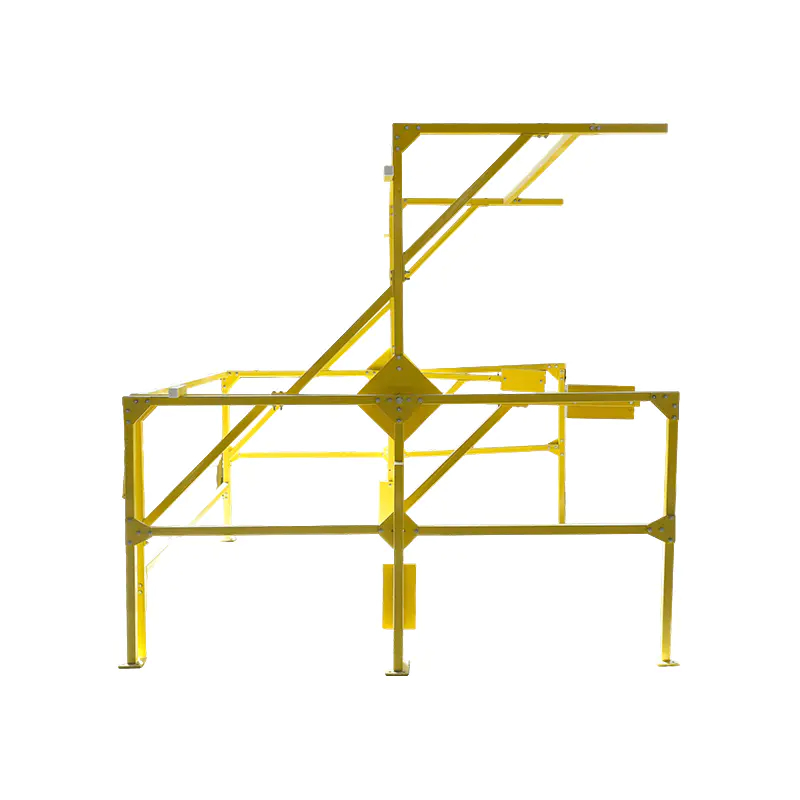
Key Features That Define a Reliable Mezzanine Gate
- Counterbalanced or interlocked ledge and rear gates that move in opposite directions.
- Four-inch kick plates on both gates and side stanchions to stop small items from sliding off the edge.
- Standard clearance heights around 82 inches, with stock widths of roughly 64 inches for single pallets and 104 inches for double pallets.
- Optional electric or pneumatic power operation with remote push buttons or radio-frequency controls for forklift operators.
- Optional containment netting or wire mesh panels to stop loose products from falling off the ledge.
Common Applications for Mezzanine Gates
Mezzanine gates are used anywhere a forklift or pallet jack needs to deliver material to an elevated surface while employees remain nearby. Typical locations include the following.
- Pallet drop openings on mezzanines and elevated storage platforms.
- Pick modules and multi-level rack systems, where a rack-supported gate can open flush with the uprights.
- Loading docks, where a gate can be set to close automatically once a trailer pulls away.
- Catwalks and production platforms with limited depth, where compact stanchion designs keep the footprint small.
How to Choose the Right Mezzanine Gate for Your Facility
Before selecting a model, walk the site and answer a few practical questions: What is the maximum pallet height and width the gate needs to clear? How much overhead clearance is available above the opening? Will the gate be operated manually or does the workflow justify power operation? Is the opening part of a rack system that requires a rack-supported design?
STG Manufacturing engineers a Mezzanine Gate line built around this dual-barrier principle, with standard and custom widths, kick plates, and optional power operation to match pallet drop zones, pick modules, and loading docks of nearly any layout. Matching the gate design to the actual pallet flow and platform dimensions, rather than choosing the cheapest generic barrier, is what keeps the gate both compliant and genuinely used every shift.