English
 Deutsch
 España
 Français
 Italia
 Русский
 عربي
عربي


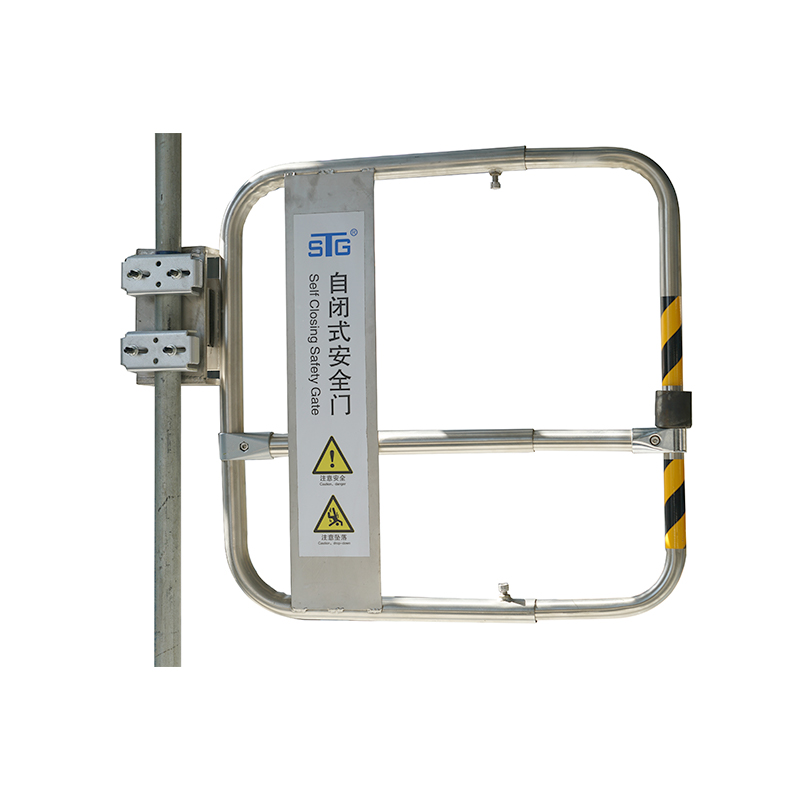
A self-closing safety gate is a barrier gate fitted with a spring-loaded or gravity-assisted hinge mechanism that automatically swings the gate shut and engages the latch after a person passes through, without requiring the user to manually close it. This design is widely used at the top and bottom of stairs, in doorways near pools, in kitchens, and on balconies and decks, specifically to reduce the risk that the gate is left open by accident after someone walks through it. Its defining feature is the automatic return-to-closed action.
The following sections explain how the self-closing mechanism works, the applicable standards, and the key factors to consider when selecting a gate for a specific application.
How the Self-Closing Mechanism Works
Spring-Loaded Hinges
Most self-closing safety gates use a spring-loaded hinge mechanism mounted at the pivot point of the gate. When the gate is pushed open, the spring is compressed or torqued, and the stored mechanical energy then drives the gate back toward the closed position once the person has passed through and released it. The closing speed is generally tuned during manufacturing to be firm enough to fully close and secure the gate, while avoiding excessive force that could create a pinch hazard or startle a person standing nearby.
Gravity-Assisted Designs
Some self-closing gates, particularly certain outdoor or heavy-duty models, rely on a gravity-assisted hinge design rather than a spring. In this configuration, the hinge geometry is angled so that an open gate is held in a position of higher potential energy, and gravity pulls the gate back down into the closed position once released. This approach can reduce the number of moving spring components, which may be a consideration for long-term outdoor durability in some product lines.
Why Self-Closing Function Matters for Personal Safety
The core safety rationale for a self-closing gate is addressing a well-documented behavioural pattern: gates and doors left open after use are a frequently cited contributing factor in incidents involving people gaining access to platforms or other hazardous areas.
Reducing Reliance on Memory and Habit
By removing the need for a deliberate closing action, a self-closing gate shifts the safety outcome away from depending on consistent human behaviour and toward a mechanical system that performs the same way every time. This is particularly relevant in environments with multiple visitors or individuals who may not have been specifically instructed on closing the gate, since the mechanism functions automatically regardless of who passes through.
Standards and Certifications Governing Self-Closing Safety Gates
Relevant standards include:
- ISO 14122-3:2016 and ISO 14122-4:2016 - Safety of machinery - Permanent means of access to machinery
- GB 17888.3-2008 and GB 17888.4-2008 - Safety of machinery - Permanent means of access to machinery (Chinese national equivalents)
Common Installation Locations for Self-Closing Safety Gates
The self-closing function is valuable across a range of installation locations, though the specific mounting method and gate dimensions required can differ significantly between these applications.
- Top of stairs: Typically requires a hardware-mounted gate fixed directly to the wall or banister, since pressure-mounted gates are generally not recommended at the top of a stairway due to the risk of the gate dislodging under force.
- Platforms: Weather-resistant self-closing gate models are used to secure outdoor elevated areas where a fall hazard exists.
Key Features to Evaluate When Choosing a Self-Closing Safety Gate
Not all self-closing safety gates are equivalent in build quality, adjustability, or suitability for a given installation. Evaluating the following features helps match a specific gate to the intended application.
- Mounting method: Hardware-mounted gates are screwed directly into a wall stud, banister, or door frame, generally providing higher holding strength suitable for the top of stairs, while pressure-mounted gates rely on tension against opposing surfaces and are typically restricted to lower-risk locations.
- Latch type and one-handed operation: Many self-closing gates include a latch designed for one-handed operation, facilitating use when carrying items or handling multiple tasks.
- Adjustable width range: Confirm the gate's adjustable width range matches the specific opening it will be installed in, since most self-closing gates are designed to fit within a stated minimum and maximum width using included extension panels or kits.
- Materials and weather resistance: Product materials are typically carbon steel with ABS surface coating, or stainless steel (SS304 / SS316L), to suit different environmental requirements.
- Adjustable closing tension: Some self-closing gate models allow the spring tension to be adjusted, which can help fine-tune closing speed and force to suit the specific gate weight and installation conditions.
Maintaining a Self-Closing Safety Gate for Reliable Performance
A self-closing gate must be inspected and maintained periodically to confirm the closing mechanism continues to function correctly over time, since the value of the self-closing feature depends entirely on the mechanism working consistently.
Routine Function Checks
Periodically test the gate by opening it fully and releasing it, confirming it swings closed completely and latches securely. If the gate fails to close fully or stops partway, this indicates the spring tension or hinge alignment requires adjustment or repair before the gate is relied upon again.
Frequently Asked Questions
Can a self-closing gate be installed at the top of a staircase
Yes, provided the specific gate model is rated and designed for top-of-stairs use and is installed using the hardware-mounted method rather than pressure mounting, since top-of-stairs installations generally require a more secure, permanently fixed mounting approach due to the consequences of a gate failure at that location.
How much force is needed to open a self-closing gate
According to relevant standards (e.g., ISO 14122-3/4 and GB 17888.3/4), the opening force should be designed to ensure reliable closing while allowing easy one-handed operation by an adult. Specific values must comply with the standard requirements. Opening force varies by product design, but quality self-closing gates are generally engineered so an adult can open the gate with one hand while the spring or gravity mechanism still provides sufficient closing force to reliably swing the gate shut, without being so stiff that it becomes inconvenient for daily use.
Is a self-closing gate suitable for pets as well as children
Many self-closing safety gates are suitable for restricting pet access in addition to child safety applications. However, for larger or more determined pets, buyers should confirm that the specific gate's structural rating and latch security are adequate for the pet's size and behaviour, since requirements can differ from those focused purely on young children.