English
 Deutsch
 España
 Français
 Italia
 Русский
 عربي



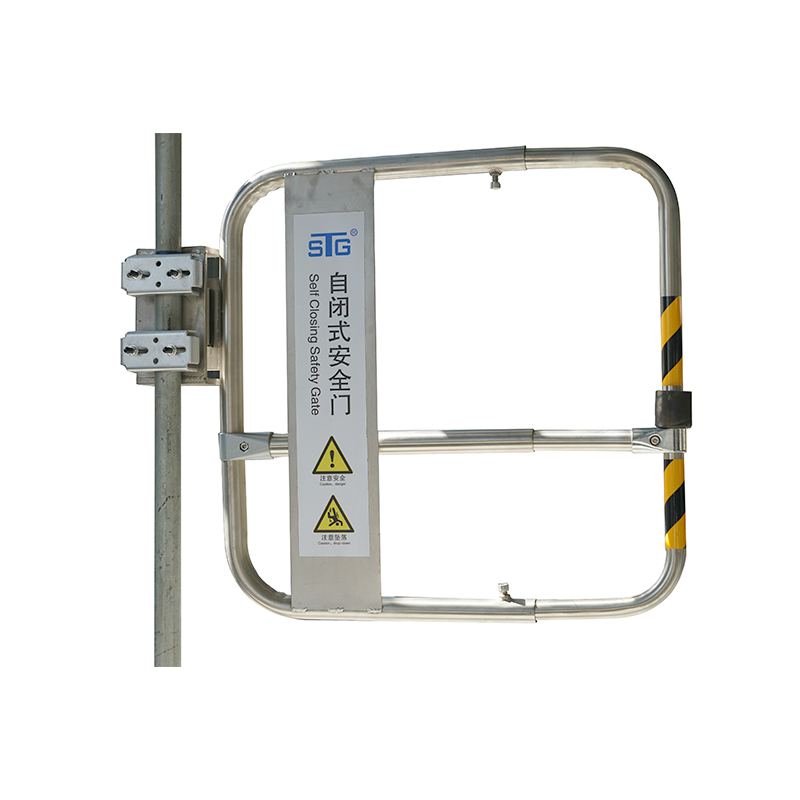
A good Self-closing safety gate must do one job without fail: return to the closed and latched position every time someone passes through, so the fall opening is never left exposed. To judge any gate, check four things: the closing mechanism, the height and strength of the gate and its frame, the material and finish for your environment, and the way it is mounted and inspected.
For most industrial platforms, mezzanines, roof hatches and ladder openings, a gravity-closing design is the more dependable choice, because it has no spring to fatigue, break or lose force. The sections below explain the key parts, the code values that apply, and a practical buying checklist.
- Closing action: gravity closing keeps a constant closing force for the life of the gate.
- Strength and height: match the guardrail rules in your region, such as the OSHA 42 inch top rail and 200 pound load test.
- Finish: choose galvanized steel, powder coating or stainless steel according to moisture, chemicals and wash down.
- Maintenance: fewer wearing parts means fewer inspection points and fewer replacements.
How a Self-Closing Safety Gate Works
A self-closing gate protects an opening in a guardrail system, such as a ladder access point, a loading edge, a stair landing or a hatch. When a person opens the gate and lets go, the gate returns to the closed position by itself and the latch engages. The aim is to remove the human factor: a gate that depends on workers remembering to close it will, sooner or later, be left open.
Gravity closing versus spring closing
There are two common ways to make a gate close by itself. A spring gate uses a coil or torsion spring to pull or push the gate shut. A gravity gate uses an inclined hinge axis or a counterweight, so the weight of the gate itself brings it back to the closed position. Both are used in industry, but they behave differently over years of daily use.
| Point of comparison | Gravity self-closing gate | Spring self-closing gate |
|---|---|---|
| Service life | No spring wear parts, so no elastic fatigue or spring breakage in high frequency use | Spring can fatigue, lose tension or break after repeated cycles |
| Closing reliability | Constant gravity force, so closing power does not fade and the gate reaches the latched position | Closing force can weaken over time, leaving the gate short of the latch |
| Weather and corrosion resistance | Simple structure without precision elastic parts, so it is less likely to jam outdoors, in corrosive air or during wash down | Springs can rust, collect dirt or seize, especially outdoors |
| Maintenance cost | Fewer wearing parts, lower inspection effort and lower spare part cost | Springs and fixings need regular checks and replacement |
The comparison above reflects general mechanical principles: any spring is a wearing component with a limited number of load cycles, while the weight of a gate does not change with use. For this reason, gravity closing is a strong fit for busy walkways, outdoor platforms and wet or corrosive plants.
Key Parts That Decide Gate Quality
Two gates may look the same in a photo and perform very differently after two years. These are the parts that make the difference.
Hinge and closing mechanism
The hinge is the heart of the gate. In a gravity design, the hinge geometry sets how firmly the gate returns and how smoothly it moves. Look for hardened pins, wear resistant bushings and a hinge that can be adjusted or replaced without cutting the gate off the frame. A hinge that is welded in permanently makes repairs far more costly.
Latch and stop
The latch should engage automatically with a clear click and should be easy to release with one hand, even while wearing gloves. A stop or a one-way swing limit prevents the gate from swinging outward toward the drop. As good practice, the gate should open inward, toward the platform or the working surface, and never out over the edge.
Frame, rails and infill
The gate frame should match the visual and strength level of the surrounding guardrail. Where a toe board is used at the edge, the gate area should keep the same protection. OSHA specifies that a toeboard must be at least 3.5 inches (about 9 cm) tall when used in general industry (source: OSHA 29 CFR 1910.29(k)). Gaps between the gate and the posts should be small enough to keep tools and hands from being trapped.
Mounting posts and fixings
A gate is only as strong as its mounting. Check that posts are fixed to structural steel, concrete or a rated base plate, and that the anchors are sized for the 200 pound test load described in the next section. Loose or rusted anchors are among the most common causes of guardrail failure found during inspections.
Codes and Standards That Apply to Gates
A gate in a fall protection system is treated as part of the guardrail, so it must meet the same height and strength rules as the rails on either side. These are the main reference points. Always confirm which rules apply in your country and industry before you buy.
| Requirement | Value | Source |
|---|---|---|
| Top rail height, general industry (United States) | 42 inches, plus or minus 3 inches, above the walking surface | OSHA 29 CFR 1910.29(b)(1) |
| Top rail load strength, general industry | Must withstand at least 200 pounds of force applied within 2 inches of the top edge, in any downward or outward direction | OSHA 29 CFR 1910.29(b)(3) |
| Top rail height, construction (United States) | 42 inches, plus or minus 3 inches | OSHA 29 CFR 1926.502(b)(1) |
| Fall protection trigger height, general industry | 4 feet or more above a lower level | OSHA 29 CFR 1910.28(b)(1) |
| Fall protection trigger height, construction | 6 feet or more above a lower level | OSHA 29 CFR 1926.501(b)(1) |
| Guard rail height for machinery access (international) | At least 1,100 mm | EN ISO 14122-3 |
| Toeboard height, general industry | At least 3.5 inches | OSHA 29 CFR 1910.29(k) |
Because the 200 pound test applies to the rail system as a whole, a gate that flexes, twists or pulls out of its posts under that load does not meet the intent of the rule, even if the rails on either side are strong. Ask the manufacturer for test data or a design statement for the gate and its recommended mounting.
Where Self-Closing Gates Are Used Most
Self-closing gates are most valuable where a guardrail must have a break for people or materials to pass, and where the opening would otherwise be left unprotected. Typical locations include:
- Ladder access openings: at the top of fixed ladders on roofs, tanks and platforms, where a person steps through the rail line.
- Mezzanine and loading edges: where pallets are moved on and off, with the gate closing behind each person.
- Roof access and rooftop equipment: where wind, rain and sunlight punish moving parts.
- Process platforms and tanks: in chemical, food and water treatment plants with frequent wash down.
- Stair landings and walkway breaks: any edge where a gate separates a path from a drop.
In outdoor and washdown settings, the simple structure of a gravity gate pays off most. There are no precision elastic parts to rust, collect dust or freeze, so the gate keeps closing in conditions that often defeat spring hardware. Our Self-closing safety gate range is designed for this kind of daily use on industrial sites.
Choosing Material and Finish for Your Environment
The material and coating decide how long the gate stays safe and presentable. Match the finish to the worst condition the gate will face, not the average one.
| Environment | Recommended finish | Why |
|---|---|---|
| Dry indoor plant or warehouse | Powder coated or painted carbon steel | Low cost and good visibility with high contrast colors |
| Outdoor, rain and sun | Hot dip galvanized steel, with or without a topcoat | Zinc coating protects the steel even where the surface is scratched |
| Coastal or chemical air, frequent wash down | Stainless steel, with grade 316 for chloride exposure | Molybdenum in grade 316 improves resistance to chlorides |
| Food and beverage production | Stainless steel with smooth, crevice free welds | Easy cleaning and low risk of contamination |
For hot dip galvanizing, ISO 1461 sets a minimum average zinc coating of 85 micrometers on steel thicker than 6 mm (source: ISO 1461, Hot dip galvanized coatings on fabricated iron and steel articles). Ask your supplier for the coating thickness and the standard used, and request salt spray test data, usually run to ASTM B117, if the gate will face harsh conditions.
Installation and Inspection Practices
Even a well built gate can fail if it is installed badly or left unchecked. A few simple habits keep it working as designed.
Installation points
- Confirm that the gate opens toward the safe side, away from the drop.
- Set the posts plumb so that the gate closes by gravity alone and not by friction or by hand.
- Anchor the posts to a structure rated for at least the 200 pound test load.
- Check that the closed gate lines up with the top rail height of the adjoining guardrail.
- Test the gate through its full swing ten times, and confirm that it latches each time without help.
Routine inspection list
- Check that the gate closes completely from a fully open position and from a half open position.
- Look for worn hinge pins, loose bolts, rust at welds and cracked paint or coatings.
- Make sure that the latch engages, and that no debris is blocking it.
- Push on the top rail of the closed gate to check for movement at the posts and anchors.
- Remove the gate from service and repair it at once if it fails any check.
A monthly check works for most sites, and a weekly check is wise for outdoor, coastal or heavy traffic gates. Record the date and result so that you can show an inspector a clear maintenance history.
Buying Checklist for a Self-Closing Safety Gate
Use this checklist when you compare suppliers. It turns the points above into questions that you can send by email and check against the data sheet.
| Question to ask | What a good answer looks like |
|---|---|
| How does the gate close | Clear description of the closing principle, and whether it uses springs or gravity |
| What rail height and load test does it meet | Reference to OSHA, ISO or local rules, with test data or a design statement |
| What are the dimensions and adjustable range | Opening width range, height, and how the gate fits uneven openings |
| What material and coating are used | Named steel grade and finish, with coating thickness or test standard |
| What mounting options are available | Wall, floor and post options with anchor details |
| Which parts wear and how are they replaced | Short list of wearing parts with spare part availability |
| What is the lead time and packaging | Clear production time, protective packaging and shipping terms |
Check the dimensions, finish options and mounting details on our Self-closing safety gate page, and send your opening size and environment to the team if you need a recommendation.
Frequently Asked Questions
Does a gravity gate close as firmly as a spring gate
Yes, for the task it is designed for. A gravity gate returns to the closed position with a constant force set by its weight and hinge angle, so the closing action does not fade as a spring does. The gate should still be tested after installation to confirm that it latches fully.
Can a self-closing gate be fitted to an existing guardrail
In most cases yes. The gate can replace a chain, bar or removable section, provided that the posts and rails on either side are strong enough to carry the same 200 pound load. If the existing rail is weak or corroded, repair it first.
How often should a gate be replaced
There is no fixed age. Replace the gate or its parts when inspection shows cracks, severe rust, bent members, worn hinges, or a failure to close and latch. Gravity gates often reach a longer service life because they contain fewer wearing parts.
Is a gate better than a chain across the opening
A gate is more reliable because it closes by itself and offers a rigid barrier. A chain or bar depends on the user to reconnect it, and it is easy to leave open or hanging. For regular access, a self-closing gate is the safer choice.