English
 Deutsch
 España
 Français
 Italia
 Русский
 عربي
عربي


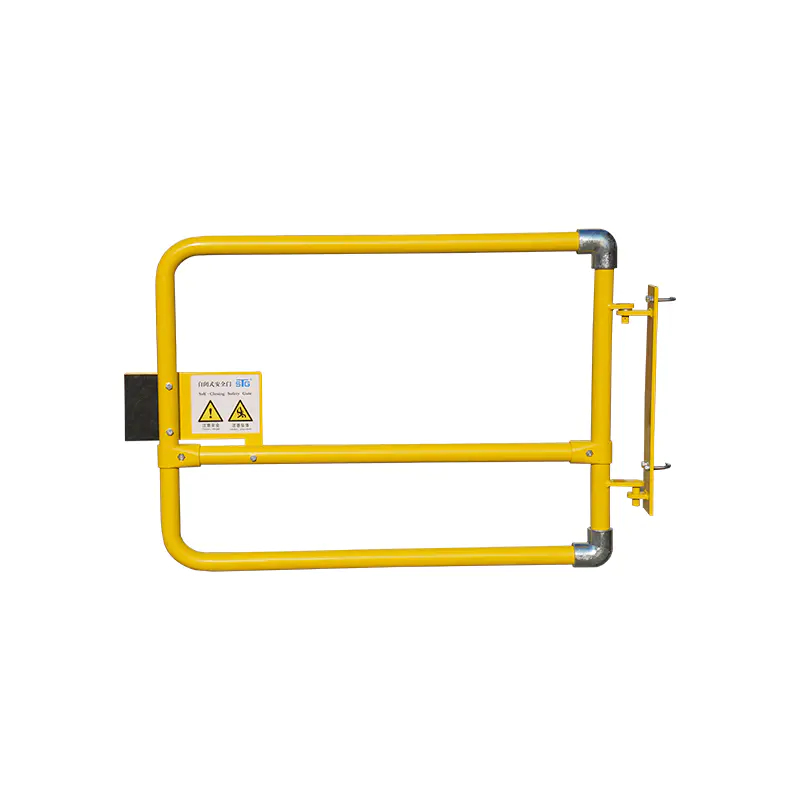
A Self-closing safety gate is the most reliable way to keep a platform or mezzanine edge protected while still allowing people and materials to pass through. For high-frequency, outdoor or washdown areas, a gravity-closing design is usually the better choice over a spring-closing design, because it has no spring to fatigue, loses no closing force over time, and needs very little maintenance.
This guide explains why self-closing gates matter, how gravity-closing and spring-closing types compare, where each type fits, how to choose a gate, how to install it, and how to inspect it. Regulatory figures are taken from public standards, and the sources are listed at the end.
Why Platform and Mezzanine Openings Need Self-Closing Gates
A guardrail only protects people while it is closed. The weak point of most platform edges is the access opening, where a chain, a bar or a manual gate is left open after a pallet is loaded or a worker walks through. A self-closing gate removes the human step: the gate returns to the closed position by itself every time.
What the regulations expect
In US general industry, OSHA requires protection on unprotected sides and edges that are 4 feet (1.2 m) or more above a lower level (29 CFR 1910.28(b)). Under 29 CFR 1910.29(b), a guardrail top rail must be 42 inches (about 1.07 m), plus or minus 3 inches, above the walking surface, and it must withstand at least 200 pounds (890 N) of force applied in any direction. Midrails must withstand at least 150 pounds. Toeboards must be at least 3.5 inches (about 89 mm) high (29 CFR 1910.29(k)).
In Europe, EN ISO 14122-3 specifies a guard-rail height of at least 1,100 mm for fixed access platforms. In practice, a gate placed in a guardrail line should be treated as part of that guardrail system, so it should match the same height, strength and gap criteria as the rails beside it.
Where a manual gate fails
- Chains and removable bars are easy to leave unhooked during busy shifts.
- Swing gates with a manual latch depend on the operator remembering to close and latch them.
- Gates left open for convenience create an unprotected edge exactly where people and forklifts are most active.
A self-closing gate addresses all three problems because the default state of the gate is closed.
Gravity-Closing vs Spring-Closing Safety Gates
There are two common ways to make a gate close by itself. A spring-closing gate uses a coil, torsion or gas spring to pull the gate shut. A gravity-closing gate uses the weight of the gate and an inclined hinge or pivot geometry so that the gate always swings back to its closed position. Both can work, but they age very differently.
Advantages of gravity-closing gates
- Longer service life: there are no wearing spring parts, so there is no elastic fatigue or spring breakage, even under frequent use.
- More stable closing: the gate is reset by constant gravity, so the closing force does not weaken over time. The gate does not stop short of the latch or fail to lock.
- Better weather resistance: the simple structure has no precision elastic components, so outdoor, corrosive and washdown environments are less likely to cause sticking or failure.
- Lower maintenance: with fewer wear parts, routine inspection is quicker and spare part replacement costs are lower.
Side-by-side comparison
| Item | Gravity-closing gate | Spring-closing gate |
|---|---|---|
| Closing force source | Gate weight and hinge geometry | Coil, torsion or gas spring |
| Wear parts | Very few | Spring, spring housing, adjuster |
| Closing force over time | Constant | Can weaken as the spring fatigues |
| Outdoor and corrosive use | Good, simple structure | Springs can rust or seize |
| Typical maintenance | Visual check, hinge lubrication | Tension checks, spring replacement |
| Best fit | High frequency, harsh conditions | Light use, indoor, space-limited spots |
A simple cycle count shows why it matters
As a simple example, a mezzanine gate used 200 times per shift on one shift per day, 250 days a year, completes 50,000 cycles per year (200 x 250). Over five years that is 250,000 opening and closing cycles. Every cycle flexes a spring if the gate has one, which is why spring wear becomes the main service issue on busy loading points. A gravity-closing gate has no spring in that load path.
Where Self-Closing Gates Are Used
A self-closing gate is most valuable wherever people or materials cross a protected edge repeatedly. The following locations are the most common.
| Location | Risk without a gate | How a self-closing gate helps |
|---|---|---|
| Mezzanine pallet loading point | Open edge while pallets are moved on and off | Gate closes as soon as the pallet is clear |
| Rooftop equipment platform | Open edge at ladder or stair exit | Gate closes behind the worker without any action |
| Ladder access opening | Fall through the ladder opening | Gate blocks the opening when nobody is climbing |
| Machine and process platforms | Gaps in the guardrail at service points | Gate keeps the guardrail line continuous |
| Washdown and outdoor areas | Spring parts corrode and stick | Gravity closing keeps working with fewer failure points |
Which gate swing direction is safest
The gate should open toward the platform side, not toward the edge. If a person leans on the gate from the walking side, the gate is pushed against its stop and stays closed. A gate that opens outward toward the drop can be pushed open by a fall or a pallet strike, so it should be avoided.
How to Choose the Right Self-Closing Safety Gate
Choosing a gate is mostly a matter of matching the opening, the strength requirements and the environment. Check these points before placing an order.
Match the opening and the rail height
- Measure the clear opening width between the fixed posts, and confirm whether the gate is for people, pallets or both.
- Confirm the gate top rail height meets your local requirement, for example 42 inches plus or minus 3 inches under OSHA 1910.29(b) or at least 1,100 mm under EN ISO 14122-3.
- Check that the gap beneath the gate and the toeboard height are consistent with the adjoining guardrail.
Check strength and mounting
The gate and its mounting posts must resist the same loads as the guardrail. For OSHA-governed sites, that means the top rail should withstand at least 200 pounds of force in any direction. Ask the supplier for load or test information and confirm the posts, base plates and anchors are suitable for the platform structure.
Choose material and finish for the environment
| Environment | Suggested finish |
|---|---|
| Indoor warehouse | Powder coated or galvanized steel |
| Outdoor or rooftop | Hot-dip galvanized steel or aluminum |
| Food, chemical or washdown area | Stainless steel or a corrosion-resistant coating |
Consider visibility
A safety yellow finish helps workers and forklift drivers see the gate and the edge from a distance. Many facilities use yellow for fall-protection hardware so that it stands out from the surrounding structure.
STG Self-Closing Safety Gate for Mezzanines and Platforms
The Self-closing safety gate from STG is designed for platform, mezzanine and equipment access openings where a manual gate is too easy to leave open. Its gravity-closing principle means the gate returns to the closed position without relying on a spring, so closing performance stays consistent in daily use.
- Gravity reset closing, with no spring to fatigue or break.
- Simple structure that is suited to outdoor, damp and washdown conditions.
- Fewer wear parts, which keeps inspection quick and spare part cost low.
- Suited to mezzanine edges, rooftop platforms, ladder openings and machine platforms.
For available sizes, finishes and mounting options, please check the Self-closing safety gate product page or contact the STG team with your opening width and installation conditions.
Installation Best Practices
Even the best gate performs poorly if it is installed on weak or misaligned posts. Follow this order on site.
- Confirm the opening width and the platform edge conditions, and check that the surrounding guardrail meets the required height.
- Fix the hinge-side post first, and make sure it is plumb, because gravity-closing action depends on correct hinge alignment.
- Set the gate so that it swings toward the platform side and rests against a stop on the closing side.
- Check that the gate closes fully from any open angle, without help, and that the latch or stop engages every time.
- Test the rail strength by applying a firm push at the top rail, and confirm there is no movement of the posts or base plates.
- Check the gap beneath and beside the gate, and fit a toeboard where the adjoining guardrail has one.
Inspection and Maintenance Checklist
A gravity-closing gate needs little maintenance, but it is still a fall-protection device and should be inspected regularly. A weekly visual check and a more detailed monthly check is a practical routine for most facilities.
| Check | What to look for | Suggested frequency |
|---|---|---|
| Closing action | Gate returns fully to closed without help | Weekly |
| Hinges and pivots | Wear, dirt, rust or a stiff movement | Monthly |
| Posts and fixings | Loose bolts, cracked welds, movement | Monthly |
| Coating and corrosion | Chips, rust or damage on the finish | Quarterly |
| Impact damage | Bent rails after a forklift or pallet strike | After any impact |
If a gate is bent, will not close by itself or has a loose post, take it out of service and protect the opening with a temporary barrier until it is repaired or replaced.
Common Mistakes to Avoid
- Propping the gate open: a gate wedged open with a pallet or a bar defeats its purpose. Provide enough space and a clear staging area so there is no reason to prop it.
- Installing the gate so that it swings outward toward the drop.
- Using a gate with a lower top rail height or a weaker construction than the guardrail next to it.
- Choosing a spring-closing gate for a busy outdoor or washdown point, and then not checking the spring.
- Skipping inspections after a forklift or pallet impact.
Frequently Asked Questions
Does a self-closing gate replace a guardrail?
No. The gate is a movable section of the guardrail system. It must be installed together with a compliant guardrail and should meet the same height and strength criteria.
Is a gravity-closing gate suitable for light-duty use?
Yes. It works equally well for light use, and its simple structure means it also stays reliable when it is used only occasionally and inspected rarely.
Can the gate be used for pallet loading on a mezzanine?
Yes, if the opening width suits the pallet size and the gate is installed so that it swings toward the platform. A double gate or a pallet gate arrangement is often used so that one gate is always closed while a pallet is in the opening.
Sources
- OSHA, 29 CFR 1910.28, Duty to have fall protection and falling object protection (osha.gov).
- OSHA, 29 CFR 1910.29, Fall protection systems and falling object protection - criteria and practices, including guardrail height, strength and toeboard requirements (osha.gov).
- ISO, EN ISO 14122-3, Safety of machinery - Permanent means of access to machinery - Part 3: Stairs, stepladders and guard-rails.
- The cycle count example is the author's own calculation based on stated assumptions, and it is not a measured industry figure.
Always confirm the requirements that apply to your site with your local safety authority, because regulations differ by country and by industry.